
Instant Pot Yogurt, Real Fermentation, and Feeding the Microbiome
There is something deeply satisfying about making yogurt from scratch. It feels both old-world and precise — milk, heat, culture, time. That’s it. No stabilizers. No “natural flavors.” No gums engineered to hold texture together.
Just fermentation doing what fermentation has always done.
Why I Started Making My Own Yogurt
When you read most commercial yogurt labels, you’ll find:
- Added flavorings (even in “vanilla” that tastes more like dessert than cultured milk)
- Thickening agents such as pectin, guar gum, locust bean gum, or modified starch
- Added sugars — often more than you’d expect
Even high-quality brands can include stabilizers to create uniform texture and extend shelf life. Those ingredients aren’t necessarily harmful, but they’re not necessary either.
When I make yogurt in my Instant Pot, the ingredient list is short:
- Organic whole milk (I add a small carton of cream too)
- A cup of plain live-culture yogurt (as the starter). After your first batch, you just take a 1 cup from your own yogurt each time.
That’s it.
The texture comes from proper heating and culturing — not additives. The outcome is alive, dynamic, and responsive.
As someone who works with skin and tissue health every day, I care about inputs. The gut–skin axis is real. Inflammation, barrier function, and collagen integrity are influenced by what’s happening in the microbiome. Fermented foods are one of the simplest ways to support that terrain.
The Process (Simple, Not Complicated) for Instant Pot Yogurt
- Add 2-3 cups of water to the Instant Pot and push the steam button for a 10 minute cycle to prepare the container.
- At the end of cycle, pour that water out (don’t rinse), and dry the container.
- Add 1/2 gallon of whole milk.
- Press yogurt button to boil.
- After that cycle, let the milk cool to 110°.
- Remove about 2 cups of milk and mix well (I use a whisk) with 1 cup of plain yogurt (preferably yours, but the simplest store bought works. Check ingredients).
- Add to Instant Pot and mix well with the milk (I add a small carton of cream at this point, I like it that way).
- Set the yogurt setting to 12 hours. I usually start early in the morning so its finished and put away by evening.
- Put in glass jars and refrigerate. Amazing!
No sachets. No powders. No mystery. What you get is a clean, tangy yogurt with active cultures intact.
Eliminating Gums and Flavorings Matters
Gums are used to improve mouthfeel and prevent separation. But when you allow fermentation to do its job, you don’t need them. True yogurt will sometimes separate slightly — that’s whey. It’s natural. Stir it back in or strain it off.
Flavorings are unnecessary when the base is properly cultured. I’d rather add fresh berries, cinnamon, or a drizzle of raw honey than consume a lab-formulated flavor system.
There’s also metabolic clarity in eating something that is fundamentally one ingredient transformed by bacteria.
Supporting the Microbiome with ZOE
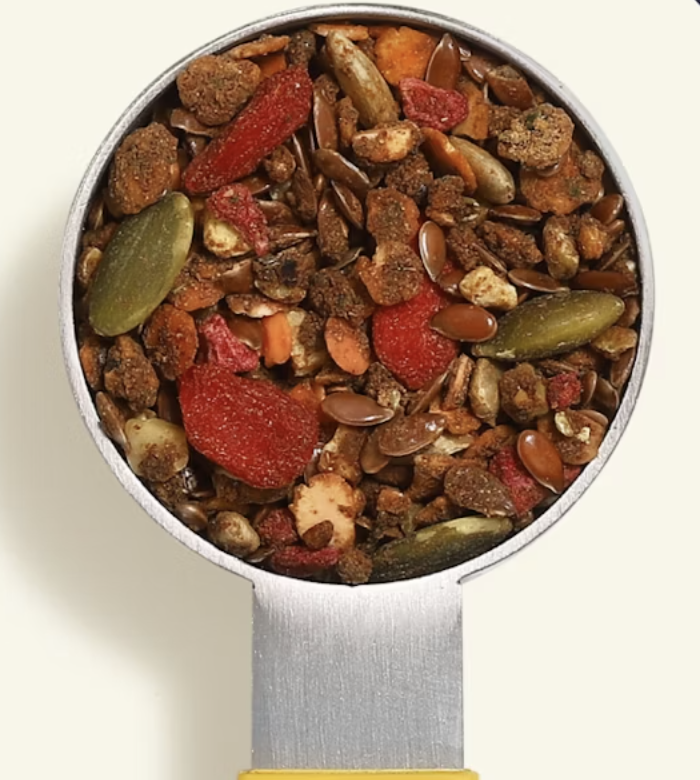
Recently, I began adding a scoop of ZOE’s plant-based supplement (Daily30) (20% off using this link) into my homemade yogurt.
ZOE’s formulation is built around diverse plant fibers and polyphenol-rich ingredients designed to nourish beneficial gut bacteria. Instead of simply introducing more bacteria (as probiotics do), this approach focuses on feeding the microbes already present — prebiotic diversity.
Why this combination works:
- Fermented dairy provides live cultures.
- Plant diversity fibers provide substrate.
- Together, they support microbial balance and short-chain fatty acid production.
For someone who prioritizes circulation, tissue resilience, and systemic calm, this feels aligned. The microbiome influences immune signaling, inflammatory tone, and even how efficiently we extract nutrients.
A well-fed microbiome supports better barrier integrity — in the gut and the skin.
My Typical Bowl
- My plain homemade yogurt
- 1 scoop ZOE Daily30
- Ground Flax or Flax Oil
- Fresh berries
- Walnuts, pumpkin seeds, hemp seeds (what do you like?)
No sweetened granola. No syrup. No flavored yogurt base.
It’s simple. Functional. Satisfying.
A Note on Balance
Homemade yogurt isn’t magic. It doesn’t compensate for chronic sugar intake or ultra-processed food habits. It’s one small lever in a larger system.
But it is a meaningful one.
When you remove unnecessary additives, return to fermentation, and intentionally feed your microbiome with plant diversity, you are supporting a foundational layer of health.
Circulation matters. Tissue health matters. The microbiome matters.
And sometimes the most sophisticated thing you can do is go back to basics — milk, heat, bacteria, time — and build from there.
Great Love!



Sounds like a great plan. Is it expensive, time consuming? How often do you make yogurt? I would need to buy an insta pot.. Or maybe find a good clean brand of yogurt to buy for now. (?) Is the ZOE reasonable $? I will look into all of this, thanks so much for sharing.
Hi Shannon, we should have tea. The cost is the whole milk (and cream), your remaining cup of yogurt and the instant pot. I save a fortune not buying yogurt. The time is in letting it inoculate. But I’m doing a lot of other things while that’s happening. Zoe seems expensive, but I view it as good food. And there is no way for me to match the diversity of veggies/plants. I tried. So, tea sometime?